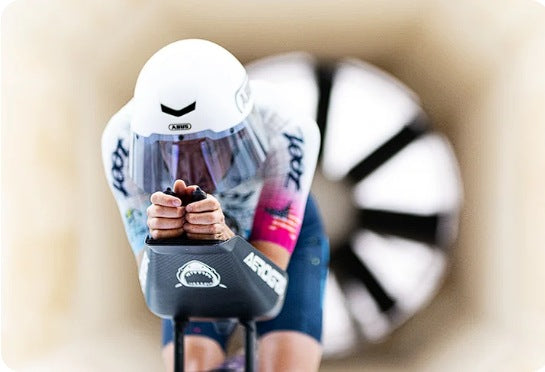
We've started running independent wind tunnel tests on products we don't make, starting with TT helmets from across the industry. All of the data is now live on our testing page.

Why we're testing products we don't sell
Aero claims are easy to make and very hard to check. Almost every helmet on the market is described as the fastest, or the most aerodynamic, or a breakthrough. Somebody has to be wrong, but unless you have wind tunnel access, you have no way of knowing who.
That's a bad position for athletes to be in. You're being asked to spend serious money on marginal gains, on the basis of claims nobody has independently checked.
So we started checking them.
We've taken TT helmets from across the industry into the wind tunnel and tested them under the same conditions, with the same athletes, on the same day. Not our helmets. Not our brand. Just the products athletes are actually choosing between.
How we ran it

We tested with three athletes — Marc Dubrick, Joran Driesen and Kellie Branagan — across a range of speeds.
Testing with more than one rider was deliberate, and it's the part we'd most like athletes to take away from this.
A helmet doesn't have a single aero number. It has a number on a particular rider, in a particular position, with a particular set of shoulders, head shape and back angle. A helmet's job is to manage airflow from your head onto your back, and every rider presents a different shape to the wind. So a helmet can genuinely be the fastest helmet in the tunnel for the athlete a brand tested it on, and not be the fastest for you.
Testing across three athletes shows which results hold up regardless of who's wearing the helmet, and which don't. Both are worth knowing.

What we tested
Helmets from across the industry, including:
- Abus
- Ekoi
- Kask
- MET
- Oakley
- POC
- Rudy Project
- Scott (both long skirt and short skirt versions)
- Uvex
Each helmet was measured on power required to hold a given speed. Lower is faster. Every number is published, including the ones that don't flatter anyone.

Some of the results were genuinely surprising. One brand's short-skirt helmet beat its own long-skirt version. One helmet that performed well on one athlete finished behind the baseline on another. And the gaps between helmets grew noticeably as speed increased — meaning helmet choice matters more the faster you race.
This is the start, not a one-off

Helmets are where we've started. They won't be where we stop.
We're going to keep taking third-party aero products into the tunnel and publishing what we find, so that athletes making equipment decisions have real testing data to work from rather than manufacturer claims.
We'll test our own products the same way, held to the same standard and published alongside everyone else's. If something we make doesn't win, that will be in the data too. That's the only way independent testing means anything.
One more thing

If you look closely at the results, you'll spot a few bars we've redacted.
There's a product in this data that we're not ready to talk about yet. What we will say is that it made every helmet it was fitted to faster, and the benefit grew the quicker the rider went.
Keep your eyes peeled.
Independent wind tunnel testing conducted with Marc Dubrick, Joran Driesen and Kellie Branagan. Full results and methodology available on our testing page.




Share:
The Search for Free Speed: Inside EZ Gain's Wind Tunnel Season
The Road to Kona: Inside the Wind Tunnel with Six IRONMAN Contenders